MORE LINEAGES
Other chains in the corpus
PLACEHOLDERS · TO BE REFINED INTO FULL CHAINS
Reading a chain
Each row is one subject caught at two or more points along its life. Read left to right as the
medium hardens — graphite, then clay, then a generative frame, then editable geometry. What you are
watching for is persistence: the silhouette that survives the jump from one tool to the next.
When a hull stencil, a horn, or a visor reappears unchanged three cells over, the lineage is no longer
a claim — it is evidence.
S1 · hand-drawn
→

S4 · generative

Seawall gate · Coalition dry-dock
hand sketch (red accent) → generative photoreal environment
S1 · the hand-drawn anchor
Most chains in this corpus begin in 3D; a true hand-drawn origin is rare, which makes this one worth
pausing on. The single red accent in the graphite is not decoration — it is the red rule of
Gothic Mechanica carried in from the very first stroke: red lives only on a body, never in the
architecture or the air. The generative frame obeys the same law it was born under.
S3 · sculpt
→

S4 · generative

Subterranean citadel · spire
3D sculpt → generative photoreal environment
Sculpt first, so the diffusion has something to obey
The citadels are built before they are photographed. A rough ZBrush mass — proportion, tier-count,
the lean of the spire — is locked in geometry first; only then does the diffusion model dress it in
fog, torchlight and weather. The sculpt is the leash. It is why two generative plates of the
same tower read as the same place under different skies, instead of two unrelated images that merely
rhyme.
S3 · ZBrush sculpt
→

S4 · generative

Recon pilot · Coalition
ZBrush sculpt → custom-LDM photoreal · the same helmet, visor and breathing rig
A face holds across the jump
The pilot is sculpted in ZBrush first — helmet, wraparound visor, the breathing rig — then realized
photoreal under the diffusion model. A face is the hardest thing to keep consistent and the first
thing an audience interrogates; that the same kit survives from grey clay to a lit frame in the
dry-dock is the whole proof in miniature. Continue to 04 · Pilots & Crew for the full-body sculpt twin and the rest of the Coalition.
S4 · generative
▸ clean 3D twin · pending upload

Hydra-class creature · generative
photoreal plate · a clean 3D twin exists and will be uploaded to close the chain (and obeys the red rule — red only on the living spine)
S4 · generative

Silver subterranean corridor · the deep machine
a generative plate built for conversion — the kind of dense, coherent frame that becomes editable geometry downstream (a motion twin of this plate already exists)
What a plate is for
A frame like the corridor above is not the end of the road — it is raw material for the next stage.
Its symmetry, depth and rivet-by-rivet density are exactly what an image-to-3D pass needs to
recover believable geometry. Hold that thought against the clean structures below: the generative
image is the quarry, and the 3D model is what we cut out of it.
S5 · 3D structure
▸ placeholder · pairs with a generative gate

S5 · 3D structure
▸ placeholder · image-to-3D output
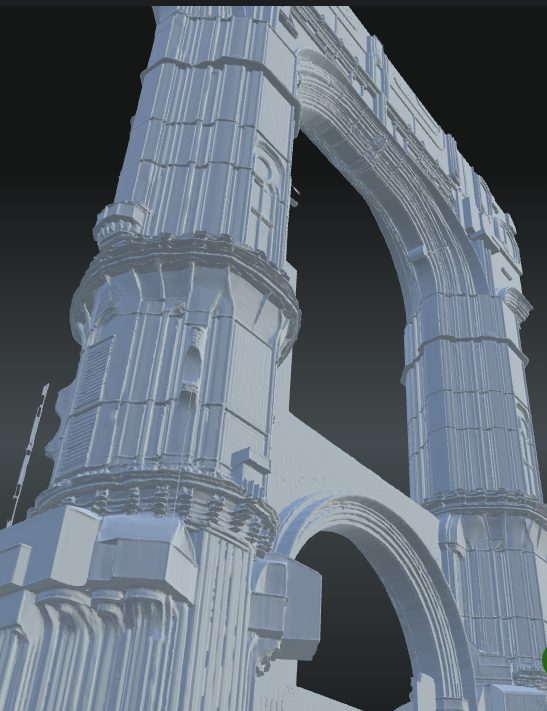
Generative structures · image → 3D
clean geometry generated from a generative image (NeRF / Gaussian-splat / image-to-3D)
S5 · the loop closes
This is the rung that turns a one-way render into a cycle. A generative plate is lifted back into
clean, editable geometry — NeRF, Gaussian-splat, image-to-3D — and re-enters the pipeline as a
buildable asset that can be cut, kit-bashed and re-staged. The image was never the
destination; it was the route back to the model. Follow any thread far enough and it returns to
3D, ready to start again.


