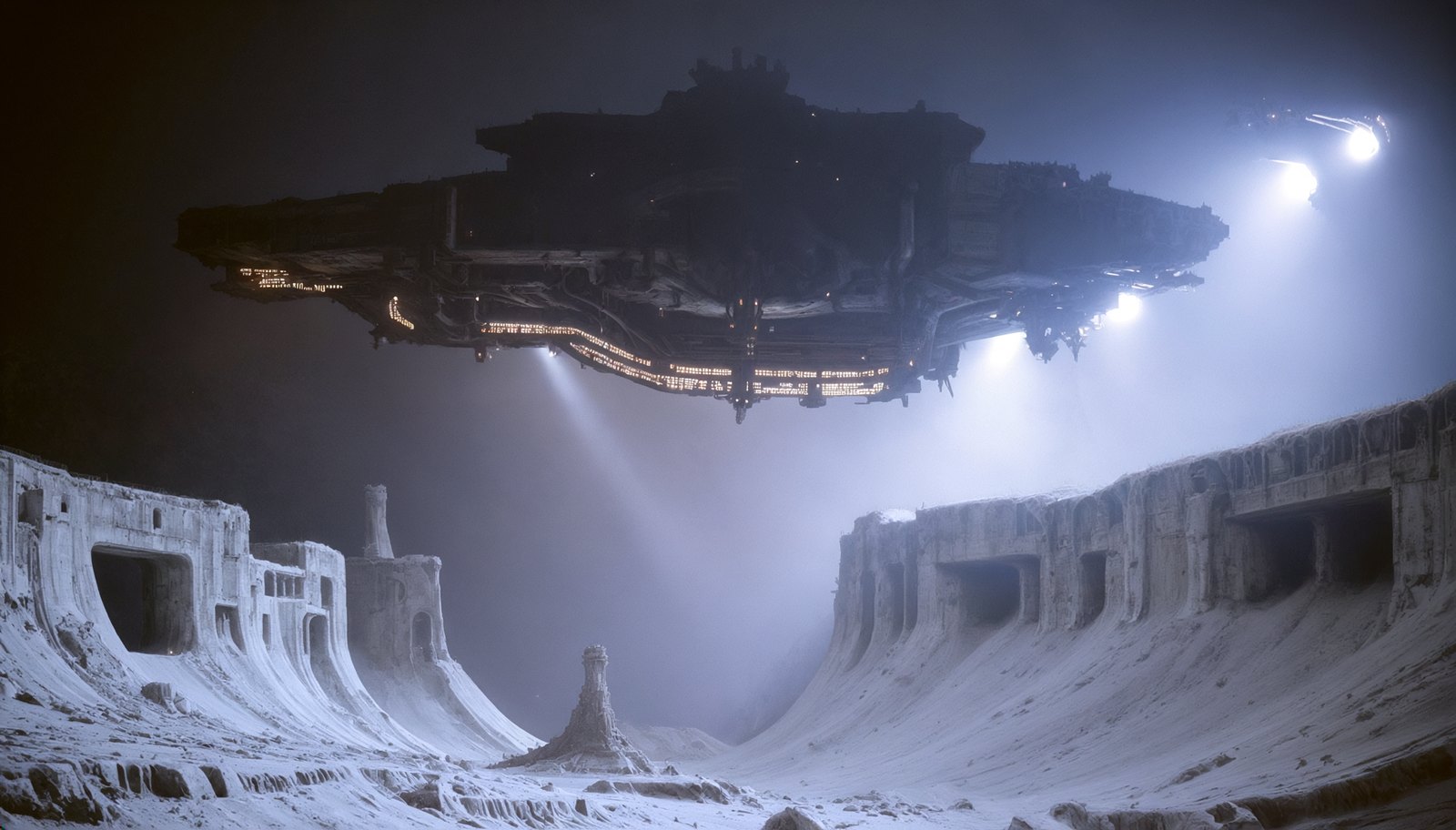
Cinematic camera physics married to dynamic lighting.
Seven rig profiles. Eight starter scenarios. Target-linked lights that hold exposure as the camera moves.
An AI Inverse Cinematography loop that matches reference frames in 30–90 seconds.
Bakes to keyframes in Blender, Maya, and Unreal — same math, same output, every host.
CITADEL CORRIDORS · 55 s · WITH SOUND · GOTHIC MECHANICA
UNMUTE FOR AUDIO
▸ FOR VIRTUAL CINEMATOGRAPHY STUDIOS
You already bought the hard part.
6-AXIS RIG · LED VOLUME · UNREAL DRIVES THE WALL
The 6-axis arm. The LED volume. Unreal driving the wall in real time. A techno-dolly that
hits the same mark to a tenth of a frame, take after take.
Form Studios,
Pixomondo PXO AKIRA,
MRMC
have spent the last five years productionising it.
What you didn't buy is the layer above it —
the one that turns a reference frame, a storyboard panel, or one line of prose into the camera move,
the key-fill ratio, and the volumetric fall-off that match it. Today a DP and a tech-vis lead
sit in a room and translate intent into fcurves by hand. That's the layer Scene Stager replaces.
A reference still goes in. The Inverse Cinematography loop recovers the camera move, the
key-fill ratio, and the volumetric fall-off that match it, then bakes deterministic fcurves on
whichever host you point it at: Blender, Maya, or Unreal.
The intermediate representation and the
inversion method are proprietary — withheld pending filing.
The techno-dolly path, the
UE VCam
animation, and the Maya post-shoot replicate are the same keyframes, by construction.
No per-host drift. No re-keying between previz and final.
Eval(plan, manifest) → USD, pure.
Interchange gate between every DCC the studio touches.
Manual STL / FBX / Alembic cleanup before USD round-trip.
Five tools, one deterministic math substrate, one USD output. They sit on top of your robotic
stage the way Sequencer sits on top of Unreal — as the layer that turns intent into the exact
motion the hardware will execute.
▸Pixomondo PXO AKIRA — UE5 + techno-dolly on 59 ft of track, one of four worldwide
▸MRMC — motion-control for frame-accurate repeatable camera moves
▸Unreal VCam Core — virtual-camera framework, any tracking source feeds it
▸SIGGRAPH 2023 — "Virtual Cinematography with Unreal Engine," camera-art best practice
These are the renderers and the rigs. ZForge is the agentic layer that decides what they execute.
▸ ROADMAP · WHERE THIS IS GOING
Six destinations the substrate is pointed at.
SHIPPED ✓ · STAGED ▸ · QUEUED →
The same deterministic compiler keeps shipping into new surfaces. Some are already green;
some are staged for the next cycle. None of them require rewriting the core — every new
adapter just exposes another DCC or another output modality to the SceneScript that already runs.
✓ SHIPPED
Cross-DCC parity
1360 / 1360 tests green. Blender ↔ Maya ↔ Unreal bake parity already proven across the line.
▸ STAGED · WALKTHROUGH LIVE
5-act demo workflow
Mock-studio loop: UE5 → 3D print → LED dome → recorded plate → corpus.
The staged walkthrough is live; authentic captures drop in act by act.
Fourth DCC adapter on the same compiler. Same SceneScript, same bake guarantees.
→ QUEUED
Volumetric NeRF / LDM backdrops
Fifth output modality joining USD / 3D print / HDR dome. Diffusion-extended infinity backdrops
trained on the scene's motif corpus.
→ QUEUED
Film-stock authoring app
DPs ship their own LUTs straight into the SceneScript vocabulary. Custom stocks alongside
Kodachrome 25 / Vision3 / Tri-X.
→ QUEUED · STUDIO-FACING
Robotic-rig path export
KUKA /
MRMC
IK targets baked alongside UE cinecam keys. The techno-dolly path comes out of the same compiler.
Updated against the live .planning/STATE.md on each milestone close.
What ships next is decided by which adapter the queued shots demand — not by a marketing roadmap.
§ 01 / 06
Three pillars, one substrate
1360 / 1360 TESTS GREEN
▸ The pivot story
Originally shipped as two separate products — Light Stager and Camera Director —
they collapsed into Scene Stager the moment we realised they were two halves of the same idea.
The lights and the camera obey the same physics. The bake is one operator.
01 · CLASSIC
Scene Stager
Pick a rig. Pick a scenario. Bake. Done.
Lights parented to the focal target stay perfectly exposed as the camera moves. A single slider drives wind drift, fog scatter, and light flicker together.
full physical-rig taxonomy (tripod → drone → handheld)
4 starter film stocks (Kodachrome · Vision3 · Tri-X)
deterministic bake DAG
rig + imperfection math — withheld
02 · AI LOOP
Inverse Cinematography
Hand it a reference still. It analyses, fits a matched look, renders a preview, critiques, calibrates, iterates — to convergence.
30–90 seconds per match. Batch operation.
multi-model AI inspector behind one protocol
winning matches promote into classic mode
extractor · calibration loop — withheld
03 · GEOMETRIC
Geometric Substrate
Each heuristic in the loop has a theorem-grade counterpart with named, bounded failure modes — closed-form constructions from discrete topology and Riemannian geometry.
The specific constructions — patent-candidate methods — withheld pending filing.
closed-form, not tuned heuristics
named, bounded failure modes
5 proven theorems — math withheld
1360
Tests green
0
Regressions
3×
DCC hosts
5
PROVEN_THEOREM
§ 02 / 06
Scientific abstract
UNIVERSALITY · GEOMETRIC TRANCHE
Inverse Cinematography as Geometric Compiler
From heuristic to theorem-grade — closed-form geometry, one substrate.
Scene Stager is a typed compiler with an AI calibration loop bolted onto its boundary.
The geometric tranche replaces every estimator inside that loop with a
closed-form construction from discrete topology, persistent homology, and Riemannian
geometry — theorem-grade where the heuristic baseline was tuned.
Architecture Withheld
The five geometric substitutions — detail removed from this build
The specific constructions that make the loop theorem-grade — each mapping a named
closed-form geometric result onto an estimator the loop would otherwise eyeball — are
patent-candidate methods.
The constructions, the math-to-effect mappings, and the equations are proprietary and
withheld pending filing.
The public claim stands: closed-form, host-portable,
fewer iterations to converge, robust to clutter.
§ 03 / 06
Module map
UNIVERSAL · HOST · IMAGE · TOPOLOGY
Architecture Withheld
Module map — internal architecture removed from this build
Scene Stager is a layered system — a typed substrate and compiler, host adapters for
Blender · Maya · Unreal, an image-metrics front-end, a fuser + calibration loop, a
persistence layer, an AI inspection/promotion layer, and the geometric topology core.
The specific module decomposition and the algorithms inside each layer are
proprietary patent-candidate methods and are
withheld pending filing.
What's public is the envelope:
~1,000+ tests greencross-DCC parity by constructionpure-math IR boundary.
FIG. SS-01 — SS-04 · FORMAL DIAGRAMS
Schemas · taxonomy · loop · coupling
FROM zforge/scene_stager & zforge_advanced
Four reference plates, in the same Nostromo Deep treatment as the math page.
The schemas behind them — the typed scene representation, the rig taxonomy, the closed
inverse-cinematography loop, and the atmospheric phase broker — are
withheld pending filing; the plates
below show the envelope only.
FIG. SS-01 · SCENESCRIPT · prose decomposes to a typed scene representation · schema withheld pending filing
Architecture Withheld
The typed scene representation — schema removed from this build
Scene Stager compiles free prose into a compact, typed scene representation: a small
set of controlled-vocabulary slots that together pin shot, lens, detail, cinema, style,
light, and atmosphere. The exact slot set, vocabularies, and target bindings are a
patent-candidate method and are
withheld pending filing.
FIG. SS-05 · HEAT-KERNEL BLOOM
· live breathing Gaussian over the grid · the diffusion equation made visible
· what atmospheric dilation looks like when it's literal physics, not artist knobs
§ 04 / 06
Reference frames
CALIBRATION TARGETS · GOTHIC MECHANICA
The Inverse Cinematography loop matches reference stills like these —
drop a frame in, get a matched 3D scene back, and ship it as a compact preset any host can re-bake.
Method withheld pending filing.
ATMOSPHERIC CALIBRATION PLATES · 7 STILLS · 35 s LOOP · GOTHIC MECHANICA CORPUS
The geometric tranche is fully realised. The remaining items are integration edges between
what shipped and the real world — each one is small, isolated, and individually mappable.
R · 01
Live Gumroad push for Scene Stager
Create the draft in the Gumroad UI · assign gumroad_product_id to the manifest · run publish.py --no-dry-run with GUMROAD_API_TOKEN. Cover, listing, dry-run all green.
▸ User · manual UI
R · 02
Blender smoke against real Eevee
Final shakedown of the matched-preview pass inside live Blender. The harness is staged and tested headless; remaining work is the live-render confirmation. Method withheld pending filing.
▸ User · run in Blender
R · 03
Host-side MISSING_TARGET_* spawn
Blender & Maya adapters honour the universal ProxyNullSpec contract by spawning Empty / Locator on unresolved selectors. Universal-layer contract shipped (Option 3); host integration is a small adapter PR.
Adapter PR
R · 04
Real reference frames per renderer
Drop 3–5 Eevee, Cycles, and Lumen reference renders into assets/calibration_refs/. The per-renderer attached fields (qualitative baselines shipped) re-fit to ground truth via the calibration loop itself.
▸ User · drop reference renders
R · 05
Research thread adopts the shared classifier
An adjacent research implementation converges onto the shared topology classifier extracted earlier. Cross-citation in place; conversion is incremental. Method withheld pending filing.
Research thread
§ 07 / 07 · STUDIO SCALE
Where this sits in the studio stack
HYBRID 3D × AI · INTEGRATED PIPELINE
Scene Stager is one node in a larger workflow: a hybrid 3D × AI film pipeline
where image-driven generation, virtual cinematography, and physical 3D-printed mini-bigatures all share one USD substrate.
Scene Stager drives lighting and camera physics from reference images.
Kitbash Conductor browses asset libraries by shape.
Topo Doctor enforces interchange-grade meshes between every stage.
HolyGrail produces clean quad topology from triangulated booleans.
Scene Composer orchestrates them all from prose prompts.
▸ Engineering roadmap · Image → Staged Scene
Drop a concept render, get a staged 3D scene.
Three tested producers converge into one deterministic bake. The plumbing is already built —
what stays public is the promise, not the recipe.
The convergence method is a patent-candidate invention
and is withheld pending filing.
Architecture Withheld
The Bridge — method detail removed from this build
The typed scene representation, the convergence socket, the additive merge, the cross-DCC
parity guarantee, and the function that lands one producer's output into the other are
proprietary and withheld pending filing.
What stays public:
reference image+ silhouette / intent
→
staged, lit, filmed 3D scene
→ identical bake across Blender · Maya · Unreal.