Nine diagrams. One universal math substrate. The Inverse Cinematography loop, the bake cascade, the geometric tranche — every named theorem with its application + tool wiring.
All plates rendered in the Nostromo Deep palette. Utilitarian science-abstract: thin strokes, corner ticks, monospace labels, off-white on black. Each figure references the shipped Python module that realises it.
Read it as one argument, not a catalog. The claim is that a creative pipeline can be made deterministic without being made rigid — and these diagrams are the proof. One substrate runs through all of them: the same flattening behind ConformalUV, the same eigenspectrum behind SpectralMesh, the same operator algebra that bakes identically on every host. The art is what the math makes possible.
Watch a Cartesian grid morph under a holomorphic function. The 90° intersections stay perfectly orthogonal as the grid aggressively warps — that's the conformal property, and it's why quad edge flow is guaranteed under HolyGrail's per-island map (S-C → BFF → isolines → quads). The math holds the angles; the topology falls out for free.
▸ Slide the morph from 0 → 1. At every point of the warp, every grid crossing remains a right angle. That's the theorem HolyGrail exploits: any simply-connected polygon maps conformally to the disk (Schwarz–Christoffel), and pulling the disk's orthogonal coordinates back through that map gives orthogonal isolines on the mesh — which are quad edges by definition.
The same math that lets HolyGrail map any polygon to the unit disk
(Schwarz–Christoffel) is also the 2D model for a black-hole horizon.
The unit circle |z| = 1
is the event horizon. Möbius transformations
(z·e^(iθ) − a) / (1 − ā·z) are exactly the hyperbolic
isometries — they preserve the Poincaré metric, so grid lines bunch
infinitely as they approach the boundary. The amber dashed ring is the
photon sphere; the orange arcs are null geodesics bending around it.
▸ Schwarzschild's embedding diagram is the paraboloid that emerges when you pull a Cartesian grid through z ↦ √z — that's the same "funnel" feel HolyGrail's BFF chart produces around a corner. The breakdown of orthogonality near the photon sphere is the breakdown of conformal flatness — exactly the regime where the geometric compiler thesis matters: where naïve Cartesian assumptions collapse and the spectral substrate takes over.
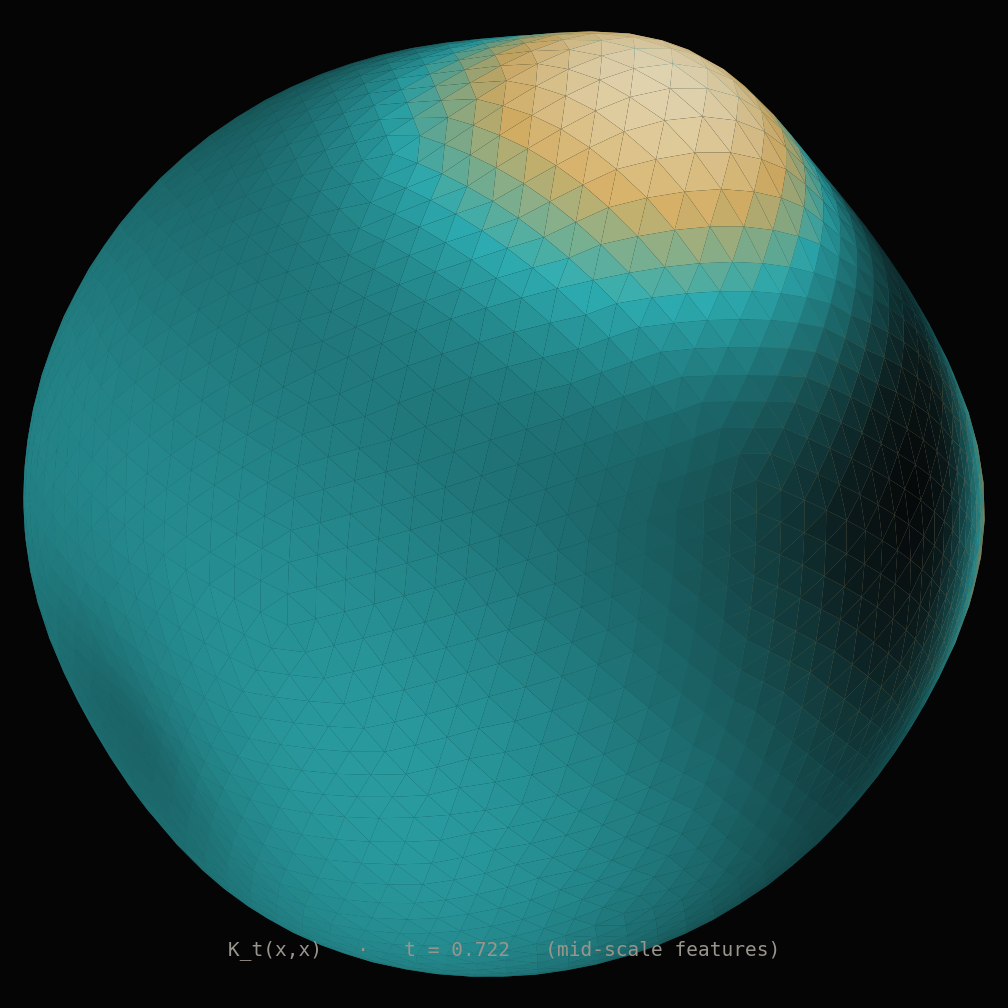
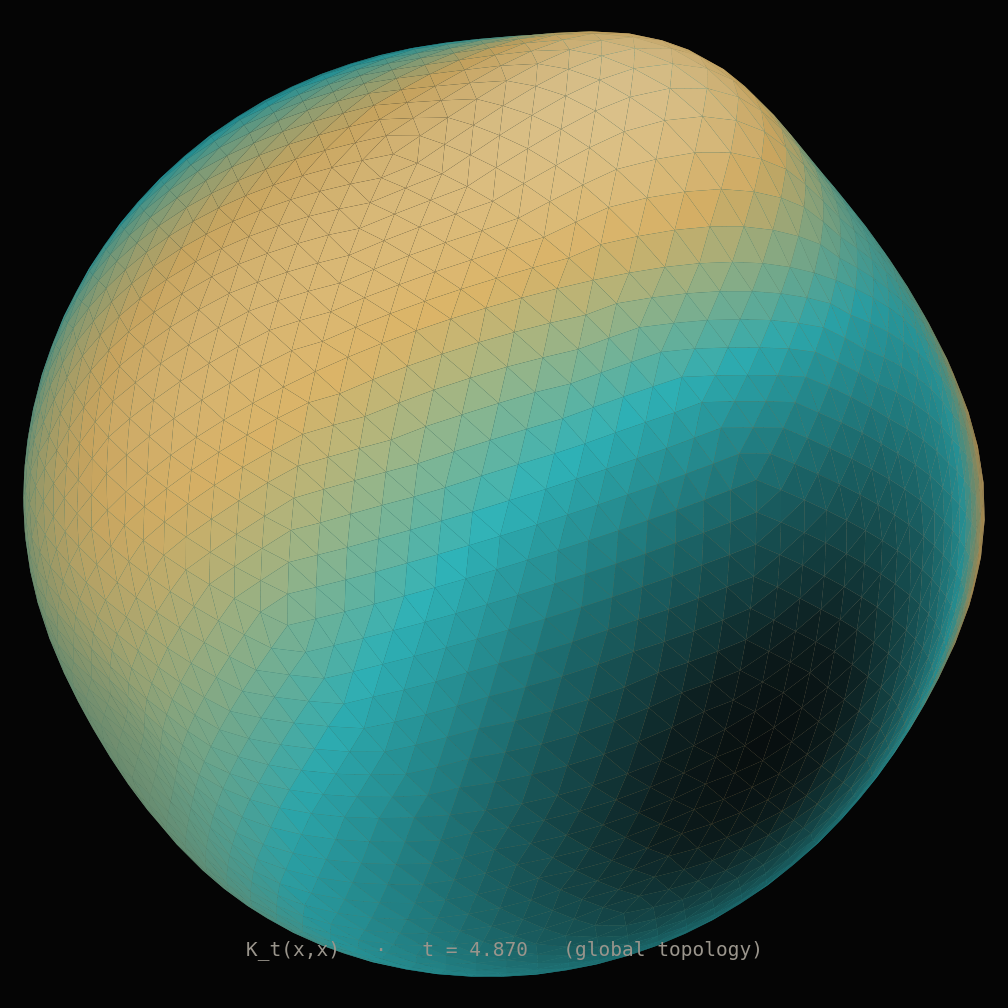
The Heat Kernel Signature Kt(x, x) = Σi exp(-λi t) φi(x)²
is the diagonal readout of the same heat semigroup that drives SOGT+ V2 attention.
The Laplace–Beltrami operator on this ZForge mesh is the Dθ running inside the transformer.
One operator, two substrates.
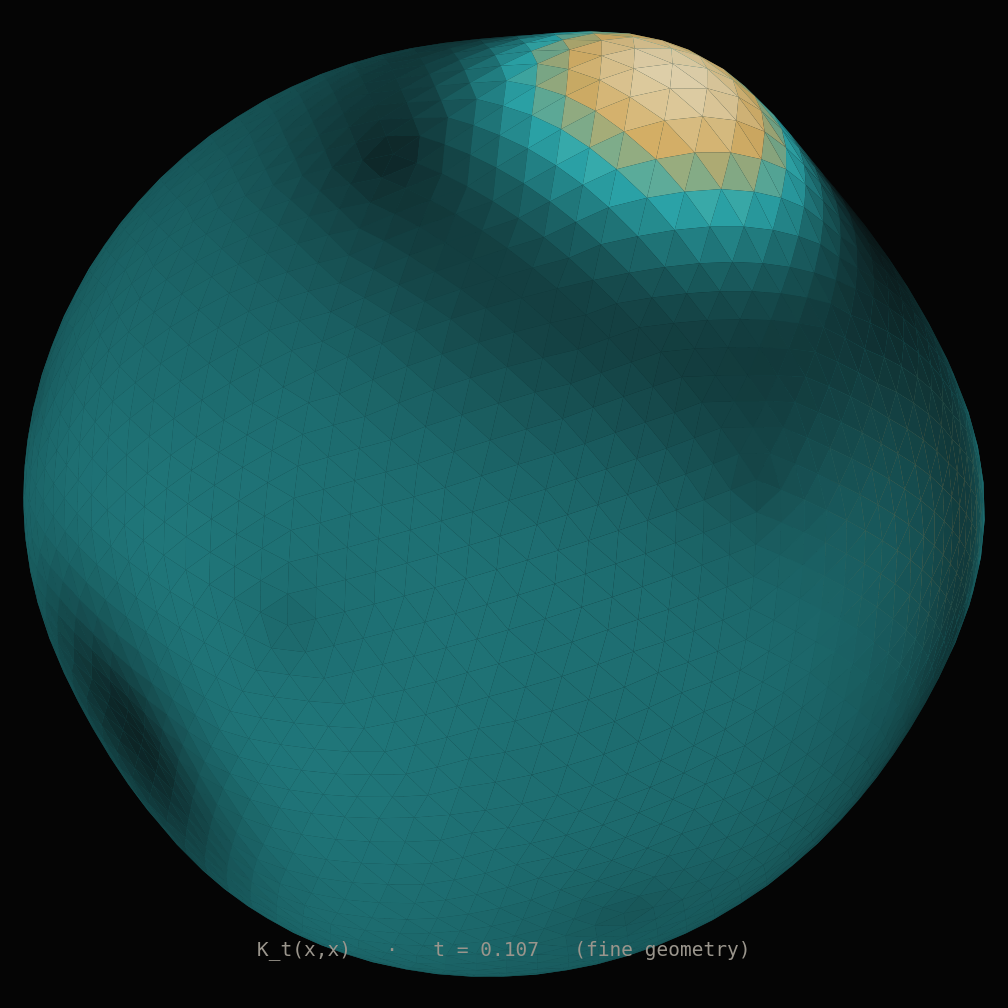
▸ Each frame is the diagonal Kt(x, x) of the heat kernel at a different diffusion time, vertex-colored on the mesh. Small t reads off fine surface curvature; large t reads off global shape. Both readings come from one Laplacian operator and its 96 lowest eigenpairs — identical machinery to the transformer's spectral attention block.
ZForge's geometry tools aren't a collection of widgets — they're one universal kernel threaded through a mesh_vertices adapter. The same block also runs on transformer tokens, render passes, skeleton graphs, scene graphs, sketch curves, and memory graphs. Same operator, same heat semigroup, seven targets.
The four pipeline plates that ship with Scene Stager covers — the typed compiler boundary, the deterministic bake, the physical-rig taxonomy, and the target-linked lighting model. Method detail withheld pending filing.
Start with the argument, not the figures. The first claim is that a creative instruction can be compiled the way source code is: a typed front door lowers to a host-agnostic intermediate representation, and only then does a host adapter emit Blender, Maya, or Unreal output. Nothing host-specific leaks across the line — which is the entire reason three DCCs produce the same keyframes. The compile is also ordered: a strict topological bake, with conditional edges that fire only when the model demands — not guesses. The representation, the bake plan, and the gate logic are patent-candidate methods — withheld pending filing.
The last two plates are where determinism meets craft. The physical-rig profiles don't fake "handheld" with noise on top — each carries its own reproducible imperfection model, and every light stays tied to its target so exposure holds as the camera moves. Together they answer the obvious objection: a deterministic pipeline should feel mechanical, and this one doesn't — because the humanity is modelled, not sprinkled on. The rig and lighting math is proprietary — withheld pending filing.
Each heuristic estimator in the Inverse Cinematography loop has a theorem-grade counterpart with named, bounded failure modes. These five plates show the substitution surfaces.
This is the second half of the argument, and the sharper one. A pipeline can be deterministic and still be wrong — deterministically wrong — if its estimators are eyeballed heuristics. So each one is replaced with a result that has a name and a bounded failure mode: closed-form constructions with known convergence basins, in place of tuned guesses. The ConformalUV unwrap and SpectralMesh score you see in the tools are the same substitutions, shipped. The specific constructions are patent-candidate methods — withheld pending filing.
What makes them a tranche rather than a list is that they share a substrate — the heat kernel and the Laplacian eigenspectrum recur across all five. Prove a property once on the substrate and it holds everywhere the substrate is used. That is why "the art stays consistent across thousands of frames" is a theorem on this page, not a promise.
Five plates set out the closed-form constructions that replace the loop's heuristic estimators — each mapping a named geometric result onto a specific cinematographic recovery. The constructions, the math-to-effect mappings, the equations, classifiers, and implementations are all patent-candidate methods, withheld pending filing.
The public claim stands: closed-form, not tuned named, bounded failure modes host-portable by construction fewer iterations to converge.
The substrate (conformal isolines, heat-kernel signature, spectral graph kernel block) is the load-bearing math under one continuous loop. Prompt becomes reference card, reference card becomes a staged scene, the skills converge into one USD scene, output branches three ways, the recorded plate drops back into the corpus. The path broadens while the look refines. The orchestration that sequences and merges the skills is withheld pending filing.