Abstract · An original synthesis of the shelf
"The compiler is the same law as the film pipeline: constraint-authored
creativity, with receipts."
— in-house synthesis, 2026
Everywhere else on this site the law shows up in pixels: a prompt grammar
holds a look to spec, a provenance ledger names the exact instruction behind every frame,
and honest badges say what is live and what is not. This shelf is the same law applied to
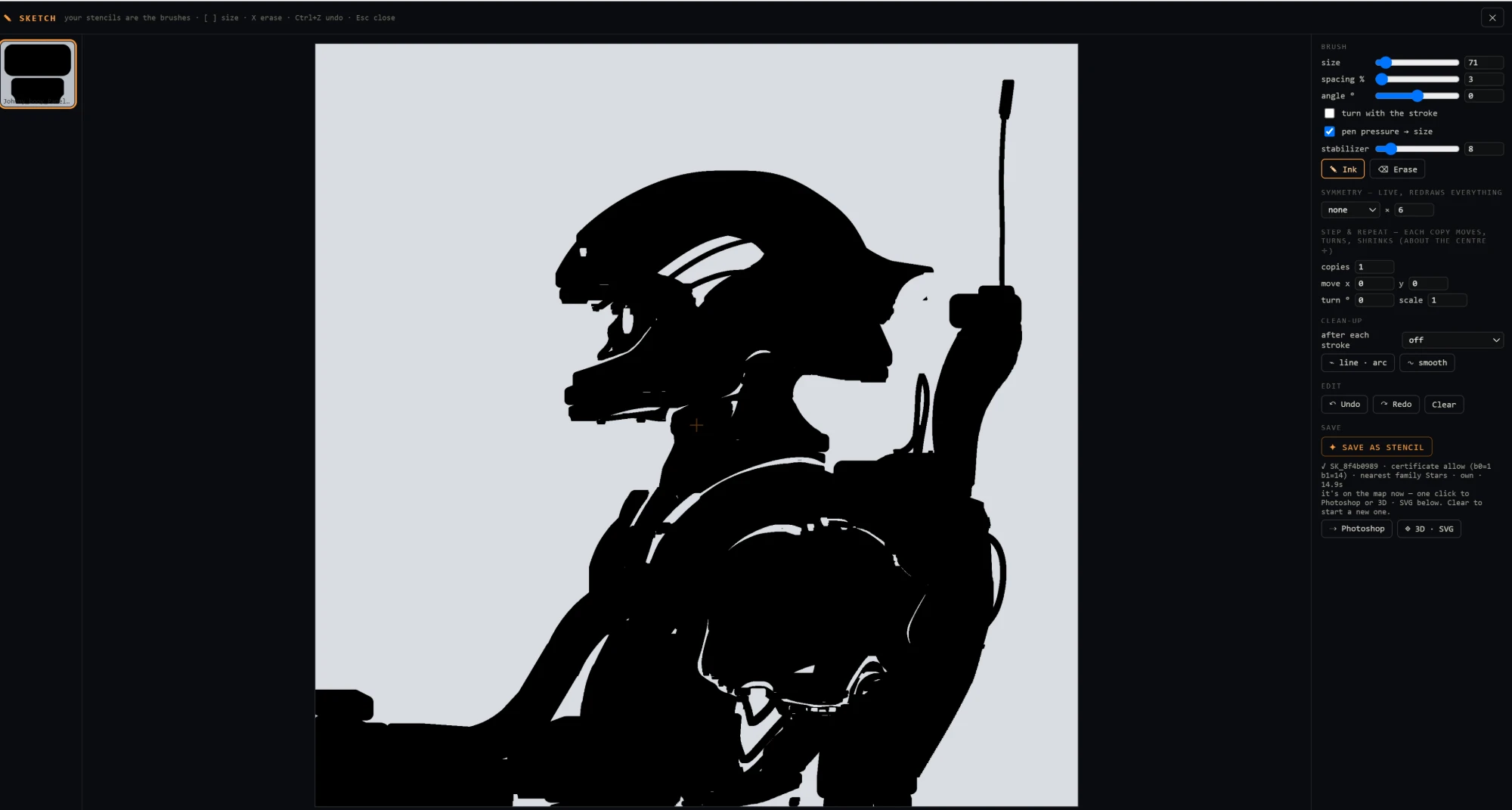
geometry. The artist's gesture is parsed into a typed curve with a confidence — an
ambiguous stroke defers instead of guessing. The edit is carried as an operator word
(split, extrude, loft, quad, comb), never as raw vertices, and the word is canonicalized
before anything touches the mesh. Realization is discrete-first: the bookkeeping —
do the quad counts add up, does the topology stay legal — is settled before any continuous
solve spends effort. A rim of sensors (spectral signatures, persistence, risk
measures) watches the build and exports evidence but holds no authority; one guard
does, grading every effect from pure to irreversible. What survives the guard is committed
with its ancestry, and stable words become macros — the corpus flywheel, on geometry.
The 2026 maturation reframes the whole stack around one move: stop
measuring meshes; interrogate them. A completed mesh already carries its incidence
structure exactly — no network has to learn what an edge means. Propagate fields through
that structure, decompose the flow into a small mathematical vocabulary, probe the shape
and read its response — and let symbolic search discover the compact laws relating
those responses, as readable formulas rather than black-box embeddings. Learning is
confined to the last step; everything upstream is mathematics with certificates.
One skeleton, many instances: the same role slots — proposer,
canonicalizer, guard, ledger, memory — reappear across the sketch compiler, the field
arm, and the procedural kernel. That transfer is the claim the word "instrument" carries
on this site.