ZFORGE · RESEARCH · THE GEOMETRIC COMPILER
SHELF 07  ·  THE THREAD THE OTHER SHELVES FEED

THE GEOMETRIC
COMPILER

An artist's gesture becomes a program, not a guess.

A compiler takes something a human writes and turns it into something a machine executes, through stages that each obey checkable rules. This shelf holds the version of that idea for 3D: a stroke, a lasso, a silhouette, a reference frame is typed, expressed as operator words, checked against a ledger before anything is solved, realized by exact geometry, and committed with lineage. Generation gives you an asset; a compiler gives you the asset — inspectable, replayable, and the same tomorrow.

TYPED INTENT OPERATOR WORDS PROOF-GATED COMMITS
Abstract · An original synthesis of the shelf
"The compiler is the same law as the film pipeline: constraint-authored creativity, with receipts." — in-house synthesis, 2026

Everywhere else on this site the law shows up in pixels: a prompt grammar holds a look to spec, a provenance ledger names the exact instruction behind every frame, and honest badges say what is live and what is not. This shelf is the same law applied to geometry. The artist's gesture is parsed into a typed curve with a confidence — an ambiguous stroke defers instead of guessing. The edit is carried as an operator word (split, extrude, loft, quad, comb), never as raw vertices, and the word is canonicalized before anything touches the mesh. Realization is discrete-first: the bookkeeping — do the quad counts add up, does the topology stay legal — is settled before any continuous solve spends effort. A rim of sensors (spectral signatures, persistence, risk measures) watches the build and exports evidence but holds no authority; one guard does, grading every effect from pure to irreversible. What survives the guard is committed with its ancestry, and stable words become macros — the corpus flywheel, on geometry.

The 2026 maturation reframes the whole stack around one move: stop measuring meshes; interrogate them. A completed mesh already carries its incidence structure exactly — no network has to learn what an edge means. Propagate fields through that structure, decompose the flow into a small mathematical vocabulary, probe the shape and read its response — and let symbolic search discover the compact laws relating those responses, as readable formulas rather than black-box embeddings. Learning is confined to the last step; everything upstream is mathematics with certificates.

One skeleton, many instances: the same role slots — proposer, canonicalizer, guard, ledger, memory — reappear across the sketch compiler, the field arm, and the procedural kernel. That transfer is the claim the word "instrument" carries on this site.
§ 01 / 04

Syntheses & specifications

"ML proposes; proofs gate; deterministic execution produces." — the workspace contract, unchanged since the first tool
SYNTHESIS · THE SPINE
Gesture → Word → Realization → Guard → Memory▸ Built
The compiler's five-stage spine. Intent: a stroke is typed with a confidence, and ambiguity defers rather than guesses. Algebra: edits travel as operator words with a canonical form. Realization: discrete legality first, continuous solving second. Authority: sensors observe without power; a single guard allows, blocks, repairs, or defers. Memory: every commit carries ancestry, and recurring words are promoted to macros. One stochastic entry point, one authority point, one ledger.
SYNTHESIS · VARIANCE
One skeleton, three architectures▹ In the forge
The compiler is not one program but a role-slot skeleton. The sketch-modeling instance, the field-and-operator arm, and the procedural rule kernel each fill the same slots — proposer, canonicalizer, admissible set, retraction, invariant ledger, authority, memory — with different substance. A new algorithm is classified into its slot before integration, so the interface, the invariants it may touch, and the tests that transfer are decided in advance. Orthogonally, one core ships to Blender, Maya, and Unreal as per-host emitters over a single substrate — never re-implemented per DCC.
SYNTHESIS · THE 2026 REFRAME
The mesh as a medium: response over measurement▸ Research
The operator-centric reformulation. A mesh's vertices, edges, and faces give exact incidence operators for free — the discrete calculus is a contract, not something a network learns. Edge flow decomposes into a semantic vocabulary (potential, circulation, topological remainder); metrics become a menu induced by operators (geodesic, resistance, heat, spectral, response) rather than a hand choice; and two shapes are compared by how they respond to structured probes rather than by coordinates — an invariant that survives remeshing, reparameterization, and representation changes.
SPEC · DISCOVERY LAYER
Symbolic laws over invariant responses▸ Research
Where learning is allowed to live. Instead of fitting a model from mesh to answer, symbolic regression searches for compact constitutive laws relating operator-derived invariants — formulas a person can read, test, and falsify. Every candidate law must survive vertex relabeling, rigid motion, refinement, and remeshing before it is believed. A minimal end-to-end prototype is fully specified: exact incidence → one Hodge-type operator → forced flow → a small invariant vector → symbolic law → six verification tests.
§ 02 / 04

One law, two media

The generative film practice and the geometry compiler are the same discipline at two scales. Each row pairs a shipped habit from the film side with its geometric twin.

Prompt grammar holds the look to spec
≡
Operator words hold the geometry to spec
Provenance ledger names every frame's exact instruction
≡
Build ledger names every mesh's word and ancestry
Badges — live, recorded, research — never blurred
≡
Effect grades — pure, read, write, irreversible — never skipped
Corpus flywheel — outputs re-enter training
≡
Operator memory — stable words become macros
Reality slider — plausible ↔ expressive, explicit
≡
Invariance ladder — topological ⊂ intrinsic ⊂ extrinsic, chosen
FIGURES

The instrument in the artist's hands

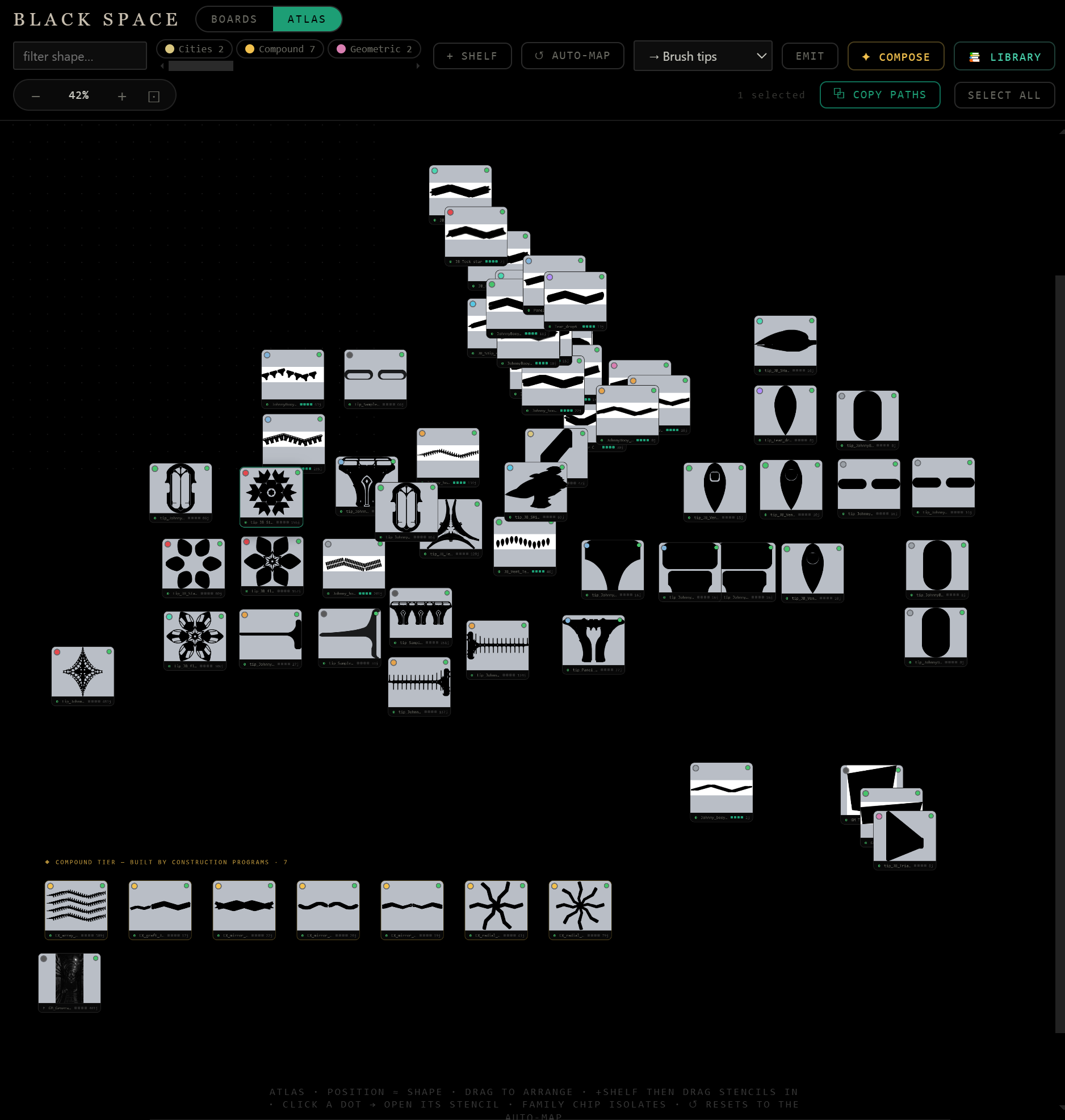
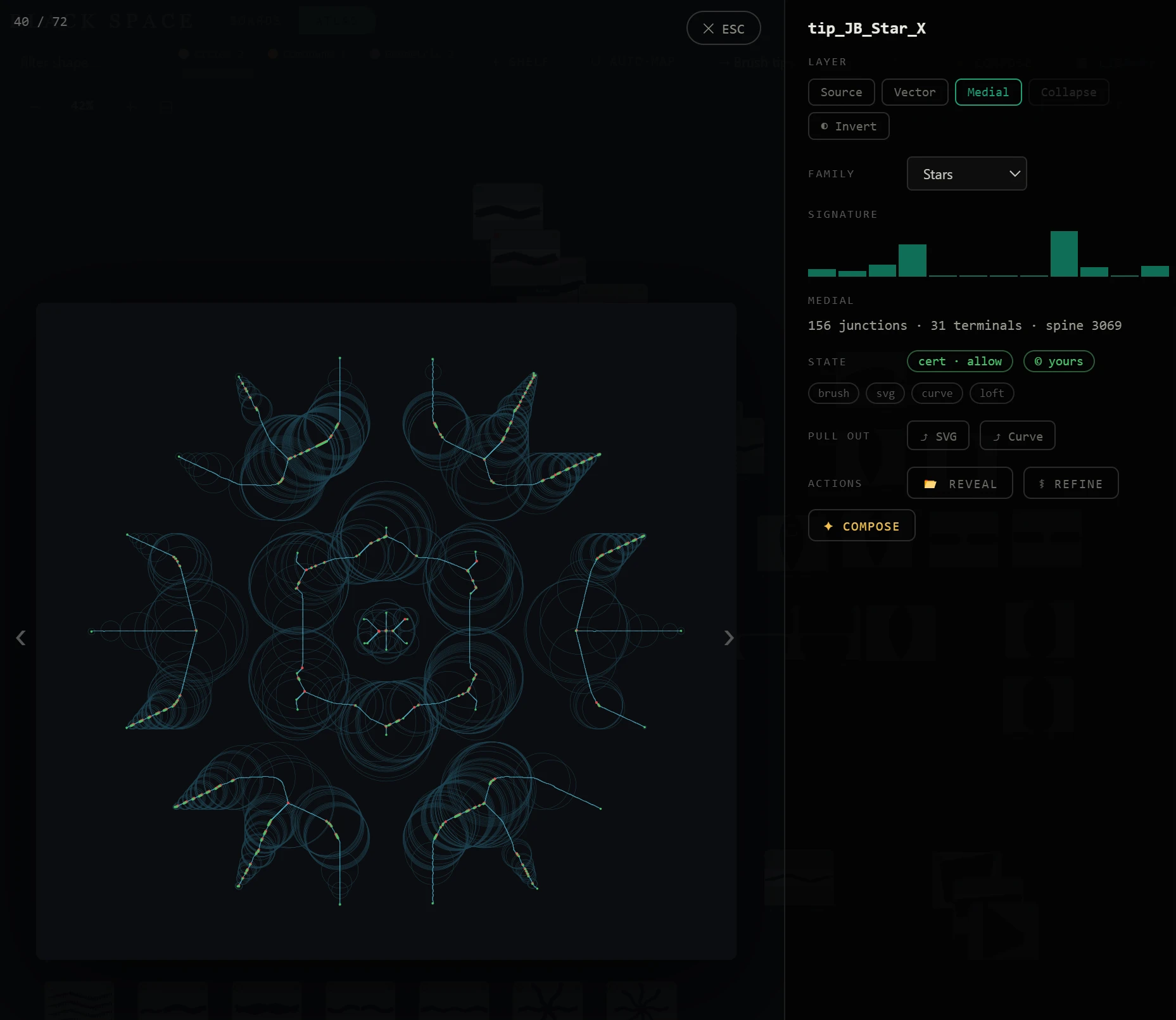
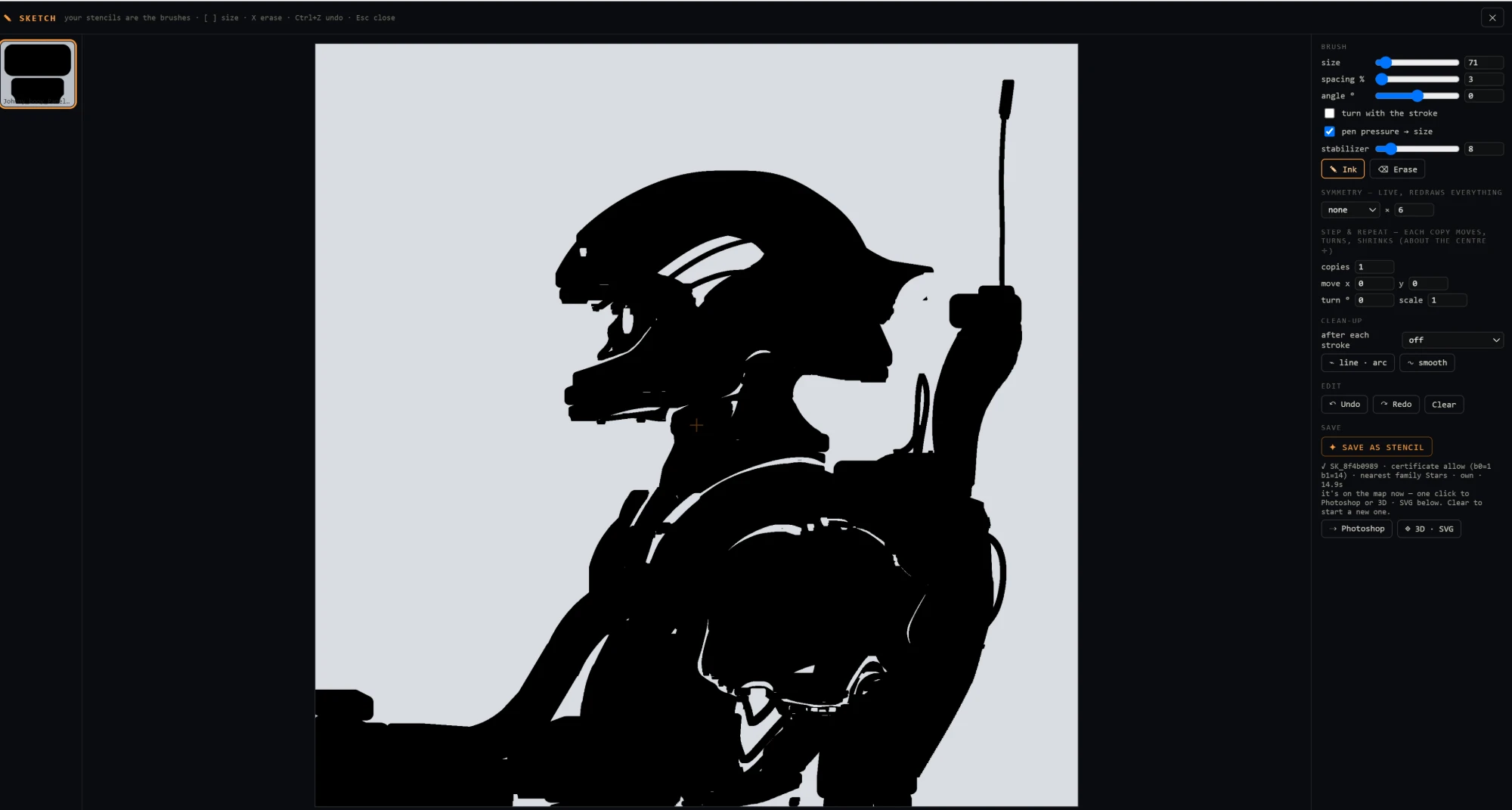
The loop, photographed rather than claimed. A freeform silhouette is drawn; the compiler certifies its topology live (certificate allow, b₀=1 b₁=14 — Betti numbers checked in an art tool), names its nearest family, and places it on the shape map — one click from Photoshop or lofted 3D. The medial panel shows what the machine actually holds: 156 junctions · 31 terminals · spine 3069 — the skeleton-and-radius IR that generates the operators.

Sketch tool certifying a drawn silhouette
SKETCH — a drawn silhouette earns its certificate (b₀=1 b₁=14 · allow · 14.9s)
Black Space stencil atlas, position approximates shape
BLACK SPACE — the stencil atlas; position ≈ shape; compound tier built by construction programs
Medial IR panel: junctions, terminals, spine
MEDIAL IR — 156 junctions · 31 terminals · spine 3069 · cert·allow — the operator generator, visible
§ 03 / 04

Built evidence

The compiler is not a proposal. Its intent layer, operator substrate, and realization solvers ship today across the suite; the response-and-discovery layer is the research frontier, specified down to its first falsifiable prototype.

Sketch-curve intent layer
Nine-module Maya toolset: multi-sensor curvature fusion, primitive intent classification, plane inference, fabric smoothing — the stroke-typing front door.
Operator substrate
A 31,700-line computational-geometry core — conformal, spectral, topology, grammar — one substrate under sixteen instruments, shipped per-DCC as emitters.
Realization with the ledger enforced: field → isolines → quad compilation, with counts settled before solving and repair as a first-class verdict.
Inverse cinematography as a response problem: a reference frame compiled into matched camera and light keyframes across Blender, Maya, and Unreal.
The Atlas
The compiler's interactive architecture map — the full stack as a navigable graph with per-node dossiers and a usage trail: the map is also the gauge.
§ 04 / 04

The papers behind the shelf